Hands-on office viewings: Why the owner showing up closes the deal
When a broker calls for a viewing, I show up. Not the property manager. Not a licensed agent. The owner himself. That signals commitment in a way no glossy PDF ever willâand it gives me the information a broker can't access.
When a broker rings to arrange a viewing on one of my office repositionings, I block my calendar. Not my asset manager. Not the leasing agent. I personally lead the tour. This is not theatrics. It is economics.
The owner showing up signals something tenants notice immediately: this building matters to the person who signed the cheque. That shifts how a prospective tenant thinks about the lease negotiation. A broker controls price and lease terms within what the asset manager has given them. The owner controls everything elseâand more usefully, tenants know it. That changes what gets asked, what gets proposed, and ultimately what gets signed.
Most office buildings run through the viewing process as a transaction stage. The broker arranges time, the agent walks the space, the landlord is somewhere on email. That process assumes tenants care about the building. In repositioning plays, tenants care about the landlord. They want to know if he will move the lease end date three months, drop the rent â¬5 a square meter on year five, or front-load the tenant improvement allowance so they avoid their own capital call. A broker cannot do those things. An owner can. And tenants know exactly who to test.
What I show during a hands-on office viewing
A viewing is not a sales presentation. It is information gathering dressed as a property tour. I have learned more from what tenants ask than from what they say they want.
I always start in the lobby and reception. That takes ninety seconds. Tenants notice this space because they will walk through it twice a day for the next five years. I show them the building security, the parcel handling, the cleanliness standard I am holding the service charge to. I do not talk about the lobby. I let them see it.
Then I walk the building floor-by-floor. Not the available space first. I show them an occupied floor to let them meet an existing tenant. This is deliberate. A prospective tenant will ask that existing tenant in the lift afterwardâwhat is the landlord really like, does he respond to maintenance calls, is the building managed tightly. I want them to hear a good story. I also listen when the existing tenant says something that contradicts what I just said. I fix it later.
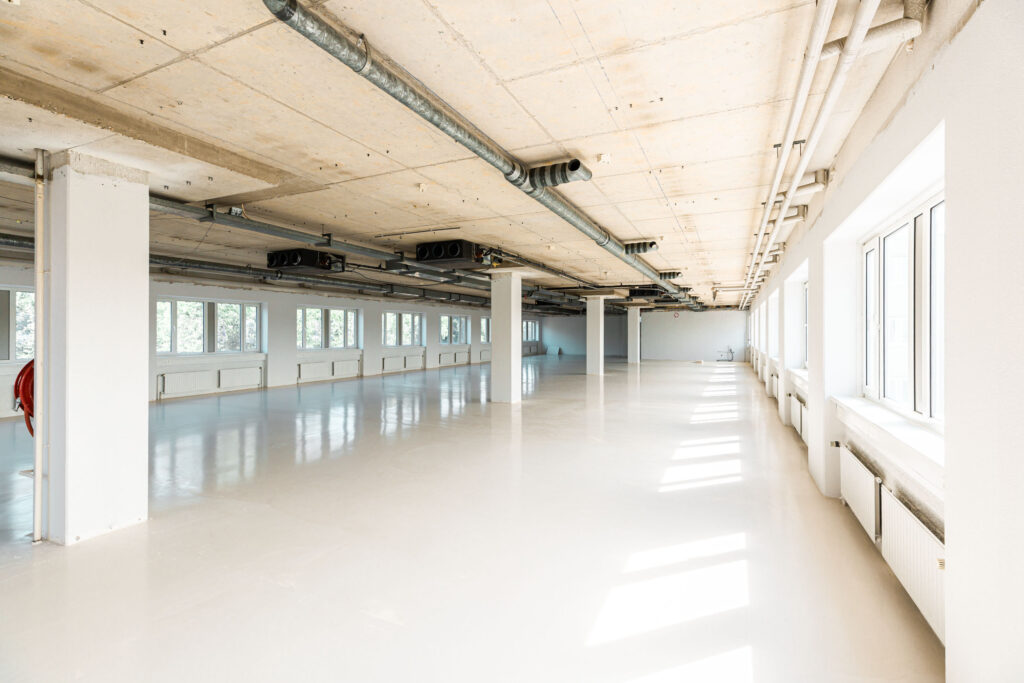
Only then do I show the available space. But I do not show it empty. I show it the way the tenant can actually use it. If a prospect is a six-person team, I do not talk about square meter. I walk them to a floor plan that is six desks, a meeting room and a kitchenette. My architect has already drafted five or six layouts based on my experience with this building's column grid and core position. I ask them how they work. Then I show them a layout that fits.
I show the mechanical spacesânot because tenants care about HVAC systems, but because I want them to see that I have invested in the physical plant. A building where the owner shows you the boiler room and the intake fans is a building that has been thought through. Most landlords do not do this. When I do, it signals that I know what I own and I am not hiding anything.
At the end, I always show the exits and the roof. The exits matter legally; showing the roof matters psychologically. Tenants in a repositioned building want to know their landlord has planned the whole assetânot just the lettable square meters. The roof is where I point out the green spaces I have built, the solar panels, the photovoltaic systems. I tell them what their annual utility cost will be in this space. I show them the BREEAM In-Use or WELL rating.
By the time I have shown them the exits and the roof, I have shown them six layers of decision-making. They have met another tenant. They have sat with a layout tailored to how they actually work. They have seen the building's bones. And I have asked them fifteen or twenty questions.
What I ask during viewings that brokers do not
A leasing agent asks about tenant profile, move-in timing, and budget. Those are transactional questions. I ask different questions, and I ask them late in the viewingâafter they have seen the space and after they have seen that I know it.
I ask how they make money. Not their business model in a general sense, but specifically how their office layout today maps to where they make revenue. I ask them about their break option strategyâwhen are they planning to need more space, less space, or to relocate. I ask them whether they have negotiated ESG clauses into their own leases and what their corporate sustainability targets are. I ask them what a failed landlord-tenant relationship looks like from their perspective.
The last question is the important one. This is where I learn what flexibility they actually need and what concerns they did not mention to the broker. I have sat with a tenant who said they wanted a ten-year lease, then said their biggest fear was landlord responsiveness if their HVAC system broke. That is not the same as their stated priority. That is the real constraint.
A broker does not ask that question because it is not a question that closes a lease faster. It is a question that surfaces the objections that kill leases after signature. I ask it because I am planning for a five-year hold, and a lease that breaks at year three because I did not respond to maintenance calls is worth nothing.
I ask what they would want in a tenant-improvement allowance if I could give them cash instead of a rent discount. Most tenants have never been asked. They assume the landlord format is fixed. When they find out they can take the allowance as capital to fit out a space the way they actually need it, that becomes the conversation that closes the deal.
How I follow up after the viewing
The broker sends a formal proposal forty-eight hours after the viewing. I call the tenant directly after the broker has followed up, usually within a week. I do not negotiate in that call. I ask what they thought of the building, what questions the viewing left unanswered, and what would make the deal work.
This call rarely closes the lease. It surfaces the real objection. I have made phone calls where the tenant said the building was perfect but their finance director wanted a break option. I have made calls where the layout worked but the rent was still too high. I have made calls where the tenant was ready to sign but wanted the parking configuration changed.
Then I do one of four things. I tell the broker I can move on a term that gets the deal done. I arrange a second viewing focused on whatever the first viewing did not answer. I have the architect redraft the layout and email it to the tenant directly. Or I tell the tenant I cannot do the deal on those terms and I move on.
The follow-up call gives me that information within ten days of the viewing. It saves me from a month of back-and-forth with the broker while I wait for them to push information to the tenant and receive a response. It also signals to the tenant that I am invested enough to call them directly. Brokers do not do this. Owners do.
Why hands-on viewings beat glossy marketing for value-add
A repositioned office building on the market has a story to tell. The building works. The capital program is complete. The layouts are modern. The energy label is A or A+. The service charge is tightly managed.
That story can be told in a PDF or a video or a virtual tour. Most brokers present it that way. The problem is every repositioned building tells the same storyâbecause the CapEx priorities are the same. HVAC, envelope, lighting, common areas, lease structure. A PDF cannot explain why my building is different. A video cannot answer the question no tenant says out loud but every tenant wants answered: is this landlord someone I can actually work with for the next five or ten years.
A viewing where the owner shows up, knows the building floor-by-floor, asks about how the tenant makes money, and calls personally to unblock the deal closureâthat is a signal no PDF can send. It says the landlord is serious. It says the landlord is capable. It says the landlord is accessible. For a tenant who is going to spend 40% of their waking hours in this space, those three signals are worth more than the architectural renders.
I have lost viewings to brokers who have bigger marketing budgets and slicker sales decks. I have not lost many to landlords who did the work I just described. The tenants who sign are the ones who decided they were betting on the landlord, not the building. That is a bet you can only win by showing up in person and proving you are worth the risk.